SimpliForm
SimpliForm
Topics:
Accessibility
SimpliForm is a technology-first solution designed to streamline the intake process for gynecologic oncology patients. Through direct collaboration with patients and staff at UPMC Magee-Womens Hospital, we created a patient-centered approach to medical forms—one that empowers patients, enhances transparency, and ensures their information is meaningfully used through clear feedback loops.
For more information around our process, check out our weekly journals: https://medium.com/@malavika.doshi/design-with-care-0d3fd9f0aaeb/
SimpliForm is a technology-first solution designed to streamline the intake process for gynecologic oncology patients. Through direct collaboration with patients and staff at UPMC Magee-Womens Hospital, we created a patient-centered approach to medical forms—one that empowers patients, enhances transparency, and ensures their information is meaningfully used through clear feedback loops.
For more information around our process, check out our weekly journals: https://medium.com/@malavika.doshi/design-with-care-0d3fd9f0aaeb/
Roles:
Lead researcher, designer, developer
Duration:
Jan 2024 - Jun 2024
Tools:
Figma

The Problem
The Problem
Form filling for gynecologic oncology patients is burdensome, with repeated requests for information across multiple modalities and unclear correlations between their inputs and the care they receive.
Form filling for gynecologic oncology patients is burdensome, with repeated requests for information across multiple modalities and unclear correlations between their inputs and the care they receive.
Current Space
Current Space
Patients undergoing gynecologic oncology treatment at UPMC Magee-Womens Hospital are required to fill out forms in a variety of formats, including paper, digital, and verbal. These forms gather similar information, often asking patients to repeat the same details multiple times, which contributes to a frustrating and fragmented experience. Additionally, the forms lack transparency; patients are not always aware of how their information is being used or where it is going. Healthcare providers also face challenges due to manual processes, where Medical Assistants (MAs) and Physician Assistants (PAs) often confirm information already provided by patients, leading to inefficiency and potential discrepancies. There is no clear system that consolidates this information for easy access, leading to delays in decision-making and frustrations in the care experience for both patients and providers.
Patients undergoing gynecologic oncology treatment at UPMC Magee-Womens Hospital are required to fill out forms in a variety of formats, including paper, digital, and verbal. These forms gather similar information, often asking patients to repeat the same details multiple times, which contributes to a frustrating and fragmented experience. Additionally, the forms lack transparency; patients are not always aware of how their information is being used or where it is going. Healthcare providers also face challenges due to manual processes, where Medical Assistants (MAs) and Physician Assistants (PAs) often confirm information already provided by patients, leading to inefficiency and potential discrepancies. There is no clear system that consolidates this information for easy access, leading to delays in decision-making and frustrations in the care experience for both patients and providers.
Understanding the Patient Journey
Most of our team, including myself, had limited experience with cancer, particularly ovarian cancer. We began with a literature review and engaging with guest speakers to understand the non-linear cancer journey, the forms patients interact with at different stages, and how demographic and cultural factors impact care access.
We quickly realized that transforming the entire healthcare system was unrealistic due to its complexity, entrenched practices, and regulatory constraints. Instead, we adopted the philosophy of "small wins"—making incremental improvements to the patient experience, focusing on specific pain points, and working within the existing system's limits.
We conducted a focus group with 8 participants to explore how young adults perceive and interact with GenAI technologies. Prior to the session, participants associated metaphors with their experiences, awareness of capabilities, trust, and the impact of over-trust in GenAI, and then explained their choices during the session. They viewed GenAI as a useful tool for automating repetitive tasks but raised concerns about trustworthiness, output quality, and over-reliance. While appreciated for low-stakes tasks like idea generation and simple coding, participants were cautious about using GenAI for complex work due to its incomplete outputs and limited understanding. Metaphors like Ladder and Broken Pencil Lead (shown above) emphasized GenAI systems’ utility but reliance on human intervention. Participants also expressed concerns about data privacy, societal dependence, and the need for transparency and education.
We decided to embrace a "small wins" mindset to create meaningful change while navigating constraints.
We decided to embrace a "small wins" mindset to create meaningful change while navigating constraints.


Shadowing and Stakeholder Mapping
Shadowing and Stakeholder Mapping

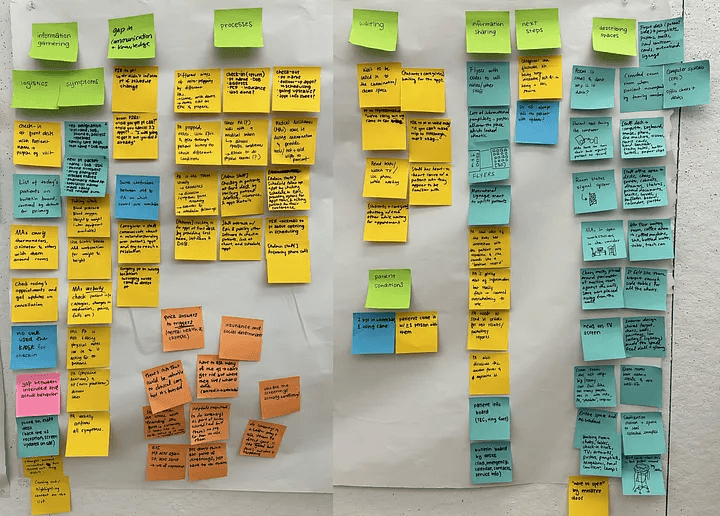
Fly-on-the-wall observation sessions at UPMC Magee-Womens Hospital were crucial to understanding the reality of patient and provider experiences. We spent time in several key areas of the hospital, including the front desk, waiting rooms, and with medical staff. Through this process, we uncovered the new patient packet, which was a set of forms we hadn't known prior. We also realized that Medical Assistants (MAs) and Physician Assistants (PAs) do not look at the prior forms or history as much as we thought and instead rely on verbal confirmation of a lot of the same information to understand the patient.
Shadowing at UPMC Magee led us to realize key issues around documentation, transparency, and accessibility of information collected.
Shadowing and Stakeholder Mapping

After pitching our narrowed ideas, we consulted with our professor, who introduced us to a game called Caution Signs and recommended that we prototype multiple game concepts. Acting on his feedback, we developed three prototypes inspired by Telestrations, Pictionary, and Caution Signs. During this process, we explored integrating GenAI into the existing game mechanics and experimented with various guessing styles, such as using lettered blanks (e.g., _ _ _) or selecting from a word list. We also tested different prompt structures, drawing from the original games.
Shadowing at UPMC Magee led us to realize key issues around documentation, transparency, and accessibility of information collected.
Interviews
Interviews
To gain a deeper understanding of the patient and provider experience, we also conducted an interview with 2 experienced healthcare staff, co-designing a user journey map with one of the two.
Some key insights from this interview:
Form Modality Preferences: In the context of a diary study one of the interviewees conducted, 50% of patients preferred electronic forms while the other 50% preferred paper forms. This highlights the importance of providing both options to accommodate diverse patient preferences.
Inefficient Processing: After forms are submitted, they are scanned into the system without any further analysis or transcription. This results in inefficiencies, as healthcare providers must manually review and process the scanned forms, leading to delays and missed opportunities for improving patient care.
Inconsistent Process: Each form is managed differently, with no consistent guide for retrieving and processing the information collected in the forms.
To gain a deeper understanding of the patient and provider experience, we also conducted an interview with 2 experienced healthcare staff, co-designing a user journey map with one of the two.
Some key insights from this interview:
Form Modality Preferences: In the context of a diary study one of the interviewees conducted, 50% of patients preferred electronic forms while the other 50% preferred paper forms. This highlights the importance of providing both options to accommodate diverse patient preferences.
Inefficient Processing: After forms are submitted, they are scanned into the system without any further analysis or transcription. This results in inefficiencies, as healthcare providers must manually review and process the scanned forms, leading to delays and missed opportunities for improving patient care.
Inconsistent Process: Each form is managed differently, with no consistent guide for retrieving and processing the information collected in the forms.

Ideation
Ideation
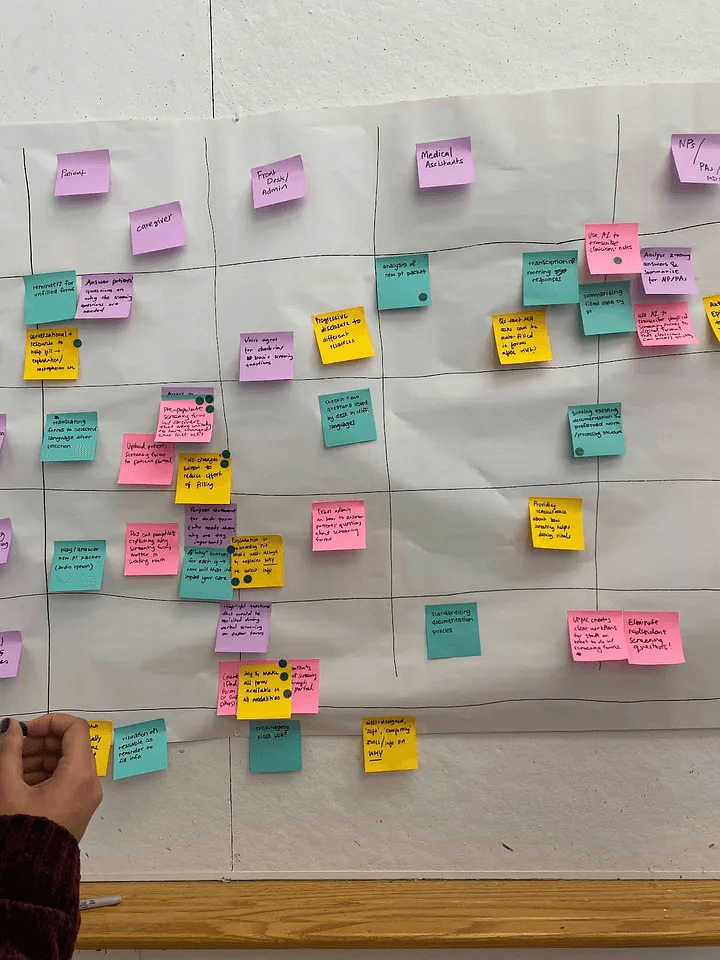

The ideation phase involved generating as many solutions as possible before narrowing them down. Using techniques like Crazy 8s, we rapidly sketched out over 30 potential ideas and narrowed down to our top 3. This approach helped us brainstorm a wide variety of concepts without getting too attached to any single one early on.
The three core solutions we decided to move forward with were:
Data Visualization: Patients can view their screening responses as well as impacts on their care through a patient portal and at check in.
Symptom Reminders: Patients complete symptom forms, and if a response exceeds a certain threshold they are prompted with questions they can bring up to their provider.
Referral Pathways: Based on a patient's responses, the system suggests and places a referral on the patient's behalf.
The ideation phase involved generating as many solutions as possible before narrowing them down. Using techniques like Crazy 8s, we rapidly sketched out over 30 potential ideas and narrowed down to our top 3. This approach helped us brainstorm a wide variety of concepts without getting too attached to any single one early on.
The three core solutions we decided to move forward with were:
Data Visualization: Patients can view their screening responses as well as impacts on their care through a patient portal and at check in.
Symptom Reminders: Patients complete symptom forms, and if a response exceeds a certain threshold they are prompted with questions they can bring up to their provider.
Referral Pathways: Based on a patient's responses, the system suggests and places a referral on the patient's behalf.
Quick ideation helped us prioritize user experience and address the established pain points.
Quick ideation helped us prioritize user experience and address the established pain points.
Midterm Presentation
Midterm Presentation

For our mid-term review, we aimed to engage both in-person and online attendees by presenting our top three ideas in five rounds of 18-minute discussions. One key insight that was brought up was to rethink our visualization of forms and the care team. The person proposed an interactive timeline, focusing on what patients have completed and what's next, rather than showing the entire process at once. This feedback led us to reconsider the linearity of the cancer journey and focus on priority of information more. Other feedback highlighted the importance of making the forms actionable and integrated into the clinical workflow.
One individual pointed out that forms should lead to immediate next steps, showing patients that their input directly influences their care. Two others echoed this sentiment, emphasizing the need for forms to go beyond data collection and actively serve the patient. Our last round focused on transparency, data autonomy, and digital accessibility, highlighting the critical need for a digital system that ensures efficiency and accuracy. These insights helped refine our approach, with a greater focus on progressive disclosure and real-time action in our design.
Using this feedback, we refocused on progressive disclosure and priorities.

Midterm Presentation

After refining the roles and gameplay, we conducted a playtest with three participants to gather feedback on the game mechanics and enjoyment. Key findings included difficulty with scoring, confusion over goals between phases (e.g., choosing a challenging prompt versus generating an easy-to-guess image), and players finding the time for generating images too short and stressful. Based on these insights, we clarified the scoring mechanism, integrated tutorials, and tested different timings, settling on 40 seconds for prompting, 60 seconds for drawing excluding GenAI’s image generation time, and 20 seconds for guessing based on the provided image.
One individual pointed out that forms should lead to immediate next steps, showing patients that their input directly influences their care. Two others echoed this sentiment, emphasizing the need for forms to go beyond data collection and actively serve the patient. Our last round focused on transparency, data autonomy, and digital accessibility, highlighting the critical need for a digital system that ensures efficiency and accuracy. These insights helped refine our approach, with a greater focus on progressive disclosure and real-time action in our design.
Using this feedback, we refocused our project to explore progressive disclosure and priorities.
Participatory Design Workshop
Participatory Design Workshop
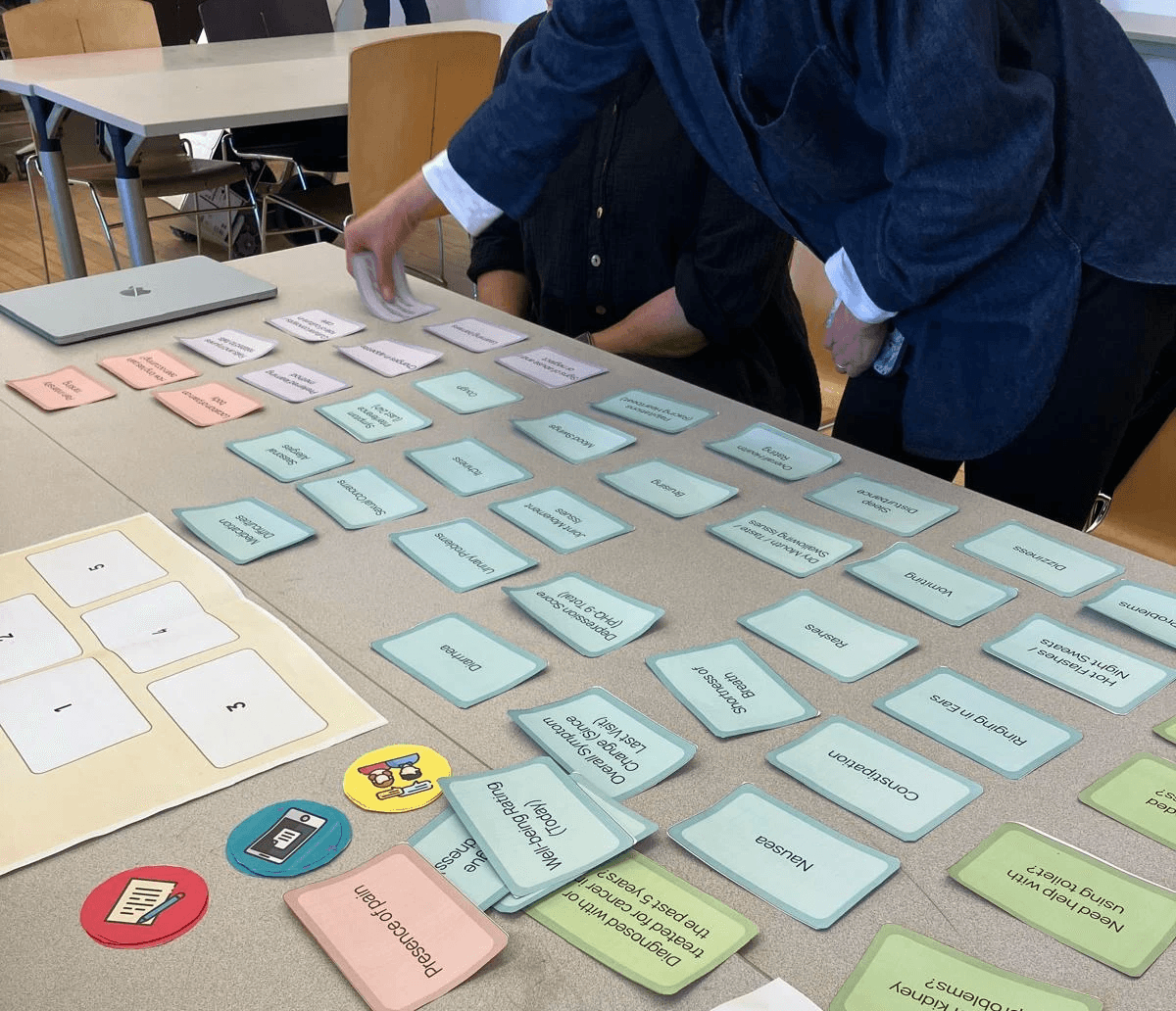
To organize screening forms in a more intuitive and user-friendly manner, we needed to determine what symptoms and questions mattered most to both patients and providers. We facilitated three sessions in a co-design workshop at UPMC Magee, as listed below, with the goal to construct decision trees and potential orderings based on the stakeholders' needs and knowledge:
Session 1 with a patient, their caregiver, and doctor
Session 2 with a medical assistant
Session 3 with a social worker and research staff member
A prominent theme across all three sessions was the providers’ focus on questions that would signal immediate clinical or logistical concerns. For example, symptoms like shortness of breath were treated as red flags warranting urgent follow-up.
Another observation was a consistent preference among both patients and providers to discuss the most pressing issues verbally. Providers emphasized that in-person conversations foster trust, allow for quicker clarification and information exchange, and often lead to appropriate and timely interventions.

Design Goals + Speed Dating


We then examined organizational principles across the field of design. We found that Richard Wurman's LATCH (Location, Alphabet, Time, Category, and Hierarchy) method would be most advantageous to us.
We also wanted to reduce cognitive load on patients, and utilized pagination and badges throughout our solution to do so. To ensure that patients were able to carry insights to their appointments and ease the review process for providers, we also created a summarized view with suggested topics to bring up in appointments.
We conducted speed dating with 10 classmates on our idea. Some of our ideas, such as the summarization and badges, were validated. The feedback made us examine where our solution falls in the overall flow for patients and providers.
We restructured form questions in order of urgency within the active treatment stage.
We also wanted to reduce cognitive load on patients, and utilized pagination and badges throughout our solution to do so. To ensure that patients were able to carry insights to their appointments and ease the review process for providers, we also created a summarized view with suggested topics to bring up in appointments.
We conducted speed dating with 10 classmates on our idea. Some of our ideas, such as the summarization and badges, were validated. The feedback made us examine where our solution falls in the overall flow for patients and providers.
Design Goals + Speed Dating
We then examined organizational principles across the field of design. We found that Richard Wurman's LATCH (Location, Alphabet, Time, Category, and Hierarchy) method would be most advantageous to us.
We restructured form questions in order of urgency within the active treatment stage.
The Solution
Participatory Design Workshop

The biggest challenge was coordinating the physical and the digital.
Defining GenAI’s role involved multiple iterations. With many materials, like the scorebook, being physical, balancing digital AI input proved difficult. As we refined gameplay, we kept the goal of creating a custom platform in mind, adjusting GenAI’s role during testing to ensure seamless integration and enhance the player experience.
A prominent theme across all three sessions was the providers’ focus on questions that would signal immediate clinical or logistical concerns. For example, symptoms like shortness of breath were treated as red flags warranting urgent follow-up.
Another observation was a consistent preference among both patients and providers to discuss the most pressing issues verbally. Providers emphasized that in-person conversations foster trust, allow for quicker clarification and information exchange, and often lead to appropriate and timely interventions.