Best Time To Buy 2.0
Best Time To Buy 2.0
Topics:
Agentic AI
Working with Consumer Reports (CR), an organization with over 6 million subscribers, we explored how agentic AI could support consumers throughout their purchasing journey. As the research lead, I defined our strategy, conducted 30+ user and stakeholder interviews, and synthesized findings into journey maps, stakeholder maps, and problem statements. These insights directly shaped our final solution—Best Time to Buy 2.0—ensuring it was rooted in real user needs and aligned with CR’s mission of trust and transparency in the marketplace.
Roles:
Lead researcher
Working with Consumer Reports (CR), an organization with over 6 million subscribers, we explored how agentic AI could support consumers throughout their purchasing journey. As the research lead, I defined our strategy, conducted 30+ user and stakeholder interviews, and synthesized findings into journey maps, stakeholder maps, and problem statements. These insights directly shaped our final solution—Best Time to Buy 2.0—ensuring it was rooted in real user needs and aligned with CR’s mission of trust and transparency in the marketplace.
Duration:
Jan 2025 - Jul 2025
Tools:
Figma
JavaScript
HTML
CSS
CSS

Overview
Overview
$2M+
predicted revenue growth
6M+
potential users
172
research participants
16
prototypes
10+
journey & process models
5
key executive presentations
Background
Background
Consumer Reports is dedicated to truth and transparency in the marketplace, and supports over 6 million consumers.
Consumer Reports is dedicated to truth and transparency in the marketplace, and supports over 6 million consumers.
Consumer Reports (CR) is an independent nonprofit founded in 1936 that empowers consumers through its unbiased reviews resulting from rigorous product testing. Beyond product ratings and reviews, CR has a long history of consumer advocacy and has played a key role in establishing safety regulations such as those for seatbelts. As products and services increasingly move online, CR advocates for digital rights, protecting consumers from data misuse, pushing for stronger privacy protections, and helping people make informed choices in the digital marketplace
Consumer Reports (CR) is an independent nonprofit founded in 1936 that empowers consumers through its unbiased reviews resulting from rigorous product testing. Beyond product ratings and reviews, CR has a long history of consumer advocacy and has played a key role in establishing safety regulations such as those for seatbelts. As products and services increasingly move online, CR advocates for digital rights, protecting consumers from data misuse, pushing for stronger privacy protections, and helping people make informed choices in the digital marketplace

The Problem
The Problem
Finding the best problem to solve with agentic AI in the Consumer Reports service ecosystem.
Finding the best problem to solve with agentic AI in the Consumer Reports service ecosystem.
Breaking Down The Problem
Breaking Down The Problem
With the initial problem statement being open-ended and ambiguous, we started by defining high-level questions stemming from the prompt:
What is "agentic AI"? What are its unique capabilities compared to other forms of AI?
Who is the "best problem" addressing?
What does the current "service ecosystem" look like?
How does CR differentiate itself in the market space? How can we leverage these differentiators and stay true to the CR brand?
With the initial problem statement being open-ended and ambiguous, we identified high-level questions stemming from the prompt:
What is "agentic AI"? What are its unique capabilities?
Who is the "best problem" addressing?
How does CR differentiate itself in the market space? How can We leverage these differentiators and stay true to the CR brand?
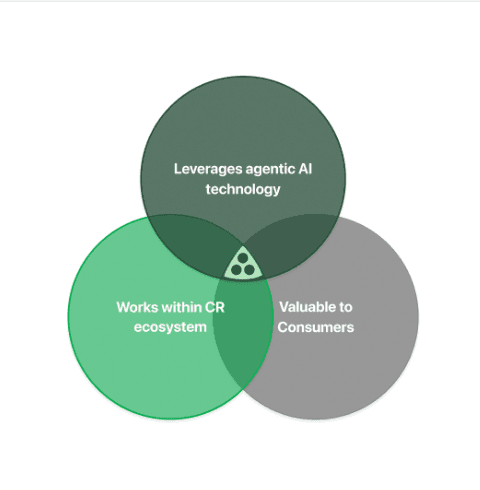
We started by exploring the nuances of agentic AI and then used a "matchmaking" approach to find the intersection of consumer value and technology.
We started by exploring the nuances of agentic AI and then used a "matchmaking" approach to find the intersection of consumer value and technology.
Additional Constraints
Additional Constraints
Through our initial exploration of CR's background and services, we learned that they've been largely focusing on helping consumers in 3 key life moments: creating a home, choosing a car, preparing for a baby. We identified client views around these moments during a kickoff meeting in New York City, and then dove deeper into the user journeys of each.
In our kickoff meeting and following client sessions, CR folks expressed the desire for our solution to be a proof-of-concept, viewing it as an opportunity to lead by example in the use of emerging technologies, In alignment with this desire, they emphasized that they should be able to quickly build and release our solution.
Through our initial exploration of CR's background and services, we learned that they've been largely focusing on helping consumers in 3 key life moments: creating a home, choosing a car, preparing for a baby. We identified client views around these moments during a kickoff meeting in New York City, and then dove deeper into the user journeys of each.
In our kickoff meeting and following client sessions, CR folks expressed the desire for our solution to be a proof-of-concept, viewing it as an opportunity to lead by example in the use of emerging technologies, In alignment with this desire, they emphasized that they should be able to quickly build and release our solution.
Our biggest challenge was ensuring our solution could be developed quickly — within as little as 3 months.


Exploring Agentic AI
Exploring Agentic AI

We reviewed 20+ online articles on agentic AI and consulted with 5+ AI subject matter experts (SMEs). From these sources, we learned what makes agentic AI unique over other forms of AI:
Agentic AI understands user intent and proactively executes complex flows with minimal user input.
To help communicate our understanding, we created a working model of Levels of Autonomy but quickly found that the distinctions between levels were nuanced and difficult to define. For instance, the role of user input is not always straightforward; it may involve initiating tasks, making adjustments, or providing feedback throughout a process. These ambiguities—regarding the degree of user involvement, the nature of human-AI collaboration, and the evolution of goals—highlight that the core issue agentic AI should address is fostering a more responsive and context-aware relationship between the technology and the user.

Exploring Agentic AI

Knowing that agentic AI should foster a more supportive relationship between technology and the user, we began a “matchmaking” process to explore potential applications within CR. We started by identifying core capabilities of agentic AI and pairing them with relevant concept ideas. For each concept, we outlined what the system would do on the user’s behalf and imagined how it might fit into CR’s broader ecosystem—based on our limited understanding at this early stage. We also considered the type and amount of data that would be required to support each concept effectively.
The idea of agentic AI being proactive really stuck with us, and we also framed the capabilities in the lens of proactively doing actions on your behalf. We consulted with 2 lead engineers at CR around their thoughts on technical feasibility of the actions as well as for our initial concepts.
Given the short dev time, we focused on AI that proactively buys, plans, monitors, and searches.
![Diagram with label "Proactively [ ] on your behalf" at top followed by ovals underneath that say "buying", "communicating", "negotiating", "planning", "monitoring", "booking", "searching", "warning". Ovals for "buying", "planning", "monitoring", "searching" are highlighted in yellow](https://framerusercontent.com/images/39gCwErS2dkXPmm9CN2HQ981pg.png?width=959&height=689)
Exploring Agentic AI

After pitching our narrowed ideas, we consulted with our professor, who introduced us to a game called Caution Signs and recommended that we prototype multiple game concepts. Acting on his feedback, we developed three prototypes inspired by Telestrations, Pictionary, and Caution Signs. During this process, we explored integrating GenAI into the existing game mechanics and experimented with various guessing styles, such as using lettered blanks (e.g., _ _ _) or selecting from a word list. We also tested different prompt structures, drawing from the original games.
To help communicate our understanding, we created a working model of Levels of Autonomy but quickly found that the distinctions between levels were nuanced and difficult to define. For instance, the role of user input is not always straightforward; it may involve initiating tasks, making adjustments, or providing feedback throughout a process. These ambiguities—regarding the degree of user involvement, the nature of human-AI collaboration, and the evolution of goals—highlight that the core issue agentic AI should address is fostering a more responsive and context-aware relationship between the technology and the user.
Exploring Agentic AI
Knowing that agentic AI should foster a more supportive relationship between technology and the user, we began a “matchmaking” process to explore potential applications within CR. We started by identifying core capabilities of agentic AI and pairing them with relevant concept ideas. For each concept, we outlined what the system would do on the user’s behalf and imagined how it might fit into CR’s broader ecosystem—based on our limited understanding at this early stage. We also considered the type and amount of data that would be required to support each concept effectively.
Exploring Agentic AI
The idea of agentic AI being proactive really stuck with us, and we also framed the capabilities in the lens of proactively doing actions on your behalf. We consulted with 2 lead engineers at CR around their thoughts on technical feasibility of the actions as well as for our initial concepts.
Given the short dev time, we focused on AI that proactively buys, plans, monitors, and searches.
CR Service Ecosystem — Identifying the Gap
CR Service Ecosystem — Identifying the Gap
To better understand what CR currently offers and who they support, we explored each feature ourselves and also interviewed 3 people who had used CR in the past or are current members. This research led us to examine CR’s offerings through the lens of the consumer purchasing journey. CR offers strong support in the pre-purchase stage through tools like ratings, reviews, and buying guides, and in the post-purchase stage through resources like the Repair or Replace tool. However, there are limited features in the during purchase phase. The Shop button on specific product pages direct users to retailer sites, but there is no way to track whether users complete the purchase.
To better understand what CR currently offers and who they support, we explored each feature ourselves and also interviewed 3 people who had used CR in the past or are current members. This research led us to examine CR’s offerings through the lens of the consumer purchasing journey. CR offers strong support in the pre-purchase stage through tools like ratings, reviews, and buying guides, and in the post-purchase stage through resources like the Repair or Replace tool. However, there are limited features in the during purchase phase. The Shop button on specific product pages direct users to retailer sites, but there is no way to track whether users complete the purchase.
CR has the opportunity to bridge a gap between product research and action by offering targeted support in the during purchase phase.


Identifying the "Best Problem"
To better understand what CR currently offers and who they support, we explored each feature ourselves and also interviewed 3 people who had used CR in the past or are current members. This research led us to examine CR’s offerings through the lens of the consumer purchasing journey. CR offers strong support in the pre-purchase stage through tools like ratings, reviews, and buying guides, and in the post-purchase stage through resources like the Repair or Replace tool. However, there are limited features in the during purchase phase. The Shop button on specific product pages direct users to retailer sites, but there is no way to track whether users complete the purchase.
CR has the opportunity to bridge a gap between product research and action by offering targeted support in the during purchase phase.
Identifying the "Best Problem"
We had a working understanding of agentic AI and saw clear potential for it to support people in decision-making and purchasing, but we lacked a grounded understanding of what would truly be valuable to consumers. To address this, we conducted 12 intercept interviews with customers and employees at Home Depot / Best Buy and 15 additional interviews with individuals from our networks. From these, key themes emerged on how consumers navigate complex purchases.
Information is everywhere, but trust is scarce — people are overwhelmed by sources and fall back on brand loyalty or in-person validation
Digital tools do not meet emotional needs, especially for high-stakes decisions
Despite AI's productivity in work settings, people hesitate to rely on it in other aspects of their life due to lack of trust and cocnerns about data privacy
Consumers lack emotional guidance and contextual trust when making decisions.


CR Service Ecosystem — Best Time to Buy
CR Service Ecosystem — Best Time to Buy


CR offers Best Time to Buy (BTTB), which informs consumers of the best months to purchase specific product categories. While helpful for high-level planning, BTTB lacks the precision needed for real-time decision-making. It presents monthly, category-level data that doesn’t account for price fluctuations or support tracking specific products. In speaking with the Product Manager, we learned the feature is based largely on anecdotal data and historical sales logic. A 2019 CR survey of 49 participants reflected similar limitations, with top addition requests including alerts for major sales and the ability to follow specific products with timely reminders.
CR offers Best Time to Buy (BTTB), which informs consumers of the best months to purchase specific product categories. BTTB lacks the precision needed for real-time decision-making. It presents monthly, category-level data that doesn’t account for price fluctuations or support tracking specific products. In speaking with the Product Manager, we learned the feature is based on anecdotal data and historical sales logic. A 2019 CR survey reflected similar limitations, with top addition requests including alerts for major sales and the ability to follow specific products with timely reminders.
Shifting BTTB from category-level estimates to dynamic, product-specific insights could allow CR to better support consumers at moments of purchase.
Shifting BTTB from broad, category-level estimates to dynamic, product-specific insights could allow CR to better support consumers at moments of purchase.
Validating a Buying Agent


The synthesis of consumer pain points and agentic AI’s potential led us to validate the concept of an AI buying agent. This direction directly addresses consumers’ desire for trustworthy, contextual guidance and echoes our earlier findings about the limitations of CR's feature BTTB. Most importantly, by grounding the agent in Consumer Reports’ trusted brand and designing it with transparency and user control at its core, we saw a clear path to overcoming skepticism around delegating purchase decisions to an AI agent.
We then explored what an AI buying agent could look like, how people could provide inputs on their criteria around price and timeline, and how much control people were willing to give to the agent. In total, we created 15 prototypes that varied in levels of autonomy, interaction styles, and involvement.
Rapid prototyping of the buying agent led to key design principles around trust and transparency.
Identifying the "Best Problem"
We had a working understanding of agentic AI and saw clear potential for it to support people in decision-making and purchasing, but we lacked a grounded understanding of what would truly be valuable to consumers. To address this, we conducted 12 intercept interviews with customers and employees at Home Depot / Best Buy and 15 additional interviews with individuals from our networks. From these, key themes emerged on how consumers navigate complex purchases.
Information is everywhere, but trust is scarce — people are overwhelmed by sources and fall back on brand loyalty or in-person validation
Digital tools do not meet emotional needs, especially for high-stakes decisions
Despite AI's productivity in work settings, people hesitate to rely on it in other aspects of their life due to lack of trust and cocnerns about data privacy
Consumers lack emotional guidance and contextual trust when making decisions.
Validating a Buying Agent
The synthesis of consumer pain points and agentic AI’s potential led us to validate the concept of an AI buying agent. This direction directly addresses consumers’ desire for trustworthy, contextual guidance and echoes our earlier findings about the limitations of CR's feature BTTB. Most importantly, by grounding the agent in Consumer Reports’ trusted brand and designing it with transparency and user control at its core, we saw a clear path to overcoming skepticism around delegating purchase decisions to an AI agent.
We then explored what an AI buying agent could look like, how people could provide inputs on their criteria around price and timeline, and how much control people were willing to give to the agent. In total, we created 15 prototypes that varied in levels of autonomy, interaction styles, and involvement.
Rapid prototyping of different parts of the buying agent led to key design principles around trust and transparency.
The Solution
Key Design Aspects
Key Design Aspects
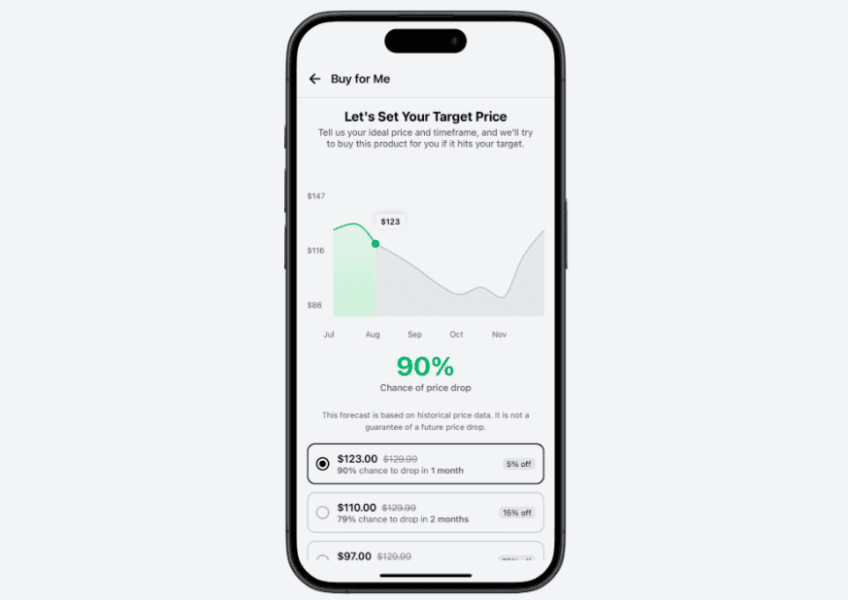
Consumers want to feel in control of finances.
Consumers want to feel in control of finances.
Several participants expressed concerns about forgetting that the agent was set to purchase on their behalf or about changing financial circumstances that might require canceling the autobuy action. To address these concerns, we introduced the ability to opt-in for notifications before any purchase, emphasized transparency around price trends and how they’re calculated, and implemented recurring push notifications to keep the agent’s activity top-of-mind.
Consumers want to be reassured they're getting the best deal.
Participants worried about setting criteria too low and missing a “pretty good” deal, or too high and missing savings. One user shared, “I want messages like, ‘hey, it’s not dropping as we expect.’” We addressed this by adding criteria recommendations, expectation updates, and guidance when original thresholds are unlikely to be met.

Feature Walkthrough
Key Design Aspects
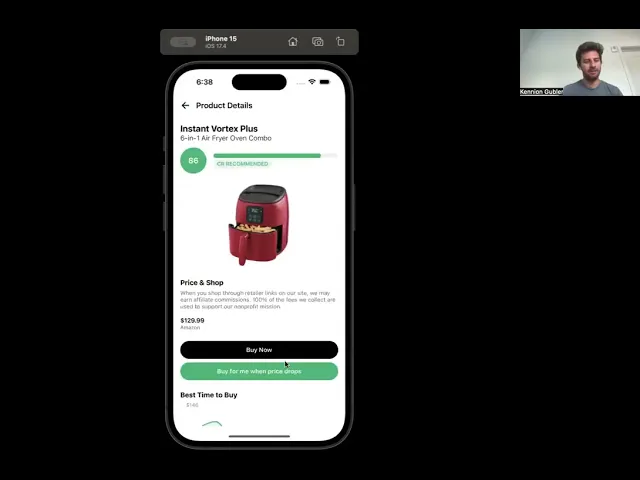
Consumers want to be reassured they're getting the best deal.
Participants worried about setting criteria too low and missing a “pretty good” deal, or too high and missing savings. One user shared, “I want messages like, ‘hey, it’s not dropping as we expect.’” We addressed this by adding criteria recommendations, expectation updates, and guidance when original thresholds are unlikely to be met.
My Learnings
My Learnings
1.
Embracing technical ambiguity in research
In a fast-moving space like agentic AI, the "target" kept shifting. As research lead, I actively tracked emerging agentic examples and designed adaptable research methods that synthesized evolving technical capabilities with real user needs. This allowed our team to make confident, informed product decisions—even as the underlying technology continued evolving.
2.
2.
Designing quiet, not flashy UI/UX for AI
Designing quiet, not flashy UI/UX for AI
With CR’s broad user base and a target audience of Millennials and Gen X, simply advertising AI wouldn’t earn trust. I led mixed-methods studies that uncovered the importance of transparency, reassurance, and control. We intentionally focused on capturing user trust while staying aligned with CR’s mission to empower consumers and foster comfort in using emerging tech.
Next Steps
Proactive personalization
Tailor product recommendations and purchasing decisions to each person's unique profile and context.
2.
Further integration
Leverage features that CR subscribers already use, such as the chatbot AskCR, to allow for purchasing in moments that are most relevant to consumers.
3.
Full-journey support
Ensure that CR is there for consumers every step of the way across large purchases through warranty, delivery, return support
My Learnings
1.
Leading research with systems thinking
As one of the primary researchers, I led a significant amount of the research and the synthesis of associated findings. In the process, I made sure to consider the larger impacts of even the smallest of decisions that we made about our game.
2.
Applying persuasive design principles
The course introduced multiple principles through lecture format, and the project allowed us to do hands-on applications of these concepts. Some specific ones we relied on were obfuscation and intermixing. We also manipulated System 1 versus System 2 thinking to ensure that people had fun while still engaging with the underlying goals of our game.
Next Steps
1.
Proactive personalization
Tailor product recommendations and purchasing decisions to each person's unique profile and context.
2.
Further integration
Leverage features that CR subscribers already use, such as the chatbot AskCR, to allow for purchasing in moments that are most relevant to consumers.
3.
Full-journey support
Ensure that CR is there for consumers every step of the way across large purchases through warranty, delivery, return support